Recovery did not arrive on the day of the sentence.
It arrived in very small pieces, over about two years, most of them boring.
Nell went back to school part-time. She started carrying three auto-injectors instead of two — one with the school nurse, one in her backpack, one with me. Every Sunday evening we sat at the kitchen table and checked all three: expiry dates, the little window that tells you the liquid is still clear, the labels.
We read the labels out loud.
Both of us, every time, out loud.
Her therapist thought that might fade in a few months. It never entirely did, and I stopped hoping it would. It is not a symptom now. It is just how we do it.
For a long time she would not sleep alone. I put a folding bed beside hers and slept in her room for eleven weeks. She woke up in the night and checked whether I was breathing, which is a thing no eight-year-old should have to think of.
She stopped wearing the smartwatch, because hearing her mother's voice made her cry and she had decided crying was something she needed to stop doing.
Dr. Maya Brooks spent a year gently taking that idea apart.
During one session, Nell asked why her grandmother wanted her money.
Dr. Brooks looked at me.
"Because she believed money mattered more than people," I said.
"Did she love me?"
"I don't know what she felt."
"She said she loved me."
"People use that word while making choices that aren't loving."
"Did Uncle Elliot love Mom?"
"Yes."
"Then why didn't he call the ambulance?"
That one took the floor out from under me.
"Because he was frightened, and he chose himself."
"Would you call?"
"Immediately."
"Even if you got in trouble?"
"Yes."
She studied my face for longer than a nine-year-old should be able to.
"Promise?"
"I promise."
She leaned against my arm, and that was the end of the session.
Children don't need perfect explanations. They need adults who tell them the truth in words small enough to carry.
Joanna finished securing the trust that spring. The court appointed an independent institution as co-trustee. I remained Nell's parent and personal representative, but no family member — including me — could move a significant sum without outside review.
Joanna asked whether the restriction offended me.
"Rebecca wanted her protected," I said. "Protection beats my pride."
Investigators recovered about four hundred and thirty thousand of the stolen money through frozen accounts and insurance. The rest went into restitution orders that will outlive all three of them.
I never cared much about the balance. The money mattered because my wife built it for our daughter, and because of what people were willing to do to get it.
What I actually wanted could not be recovered from an account.
I wanted the forty-one minutes back.
I sold the house. People assumed I was running from it. I wasn't — I sold it because my daughter checked every doorway in it, and because I stood in that kitchen replaying every sign I had walked past for eighteen months.
We moved into a smaller place four streets from her school. Nell picked a yellow bedroom. She put her mother's photograph on the nightstand and the smartwatch in a glass box on her desk, not because it was still evidence, but because it had carried her mother's voice and then it had saved her life.
Joanna gave me Rebecca's letter that autumn. Police had found it in the storage unit, opened, still in its envelope.
I read it after Nell was asleep.
Adrian,
I've found something serious involving my mother and Elliot. I'm still gathering proof and I need you not to confront either of them until I've spoken to Joanna.
If I'm wrong I'll apologise to everyone. If I'm right, I need you to protect Nell from people who think family entitles them to run her life.
You trust too easily, because you want the people you love to be good. It's one of the reasons I married you. It's also why I'm writing this down instead of saying it.
Don't let grief take your judgment.
Nell doesn't need the richest family. She needs the safest one.
I love you.
Rebecca
For two years I had believed my failure was not noticing my wife was ill.
That was never the failure.
The failure was letting two people tell me what had happened, because believing them was easier than imagining what they were.
She had known that about me. She hadn't held it against me. She had just tried to get ahead of it.
A year after the luncheon, the hospital held its next charity event.
The board invited us. I said no.
Then Nell said, "I want to go."
"You don't have to."
"I know."
"Then why?"
"Because Grandma made all those people think you forgot my medicine."
"The truth is public now. It was in the papers."
"They heard it from the papers," she said. "I want them to hear it from me."
Dr. Brooks helped her write nine sentences.
They held it in a different ballroom. Every dessert was labeled. A clinical team had signed off on the menu. There were no children on the stage as decoration.
Nell walked up in a plain blue dress and adjusted the microphone down about a foot.
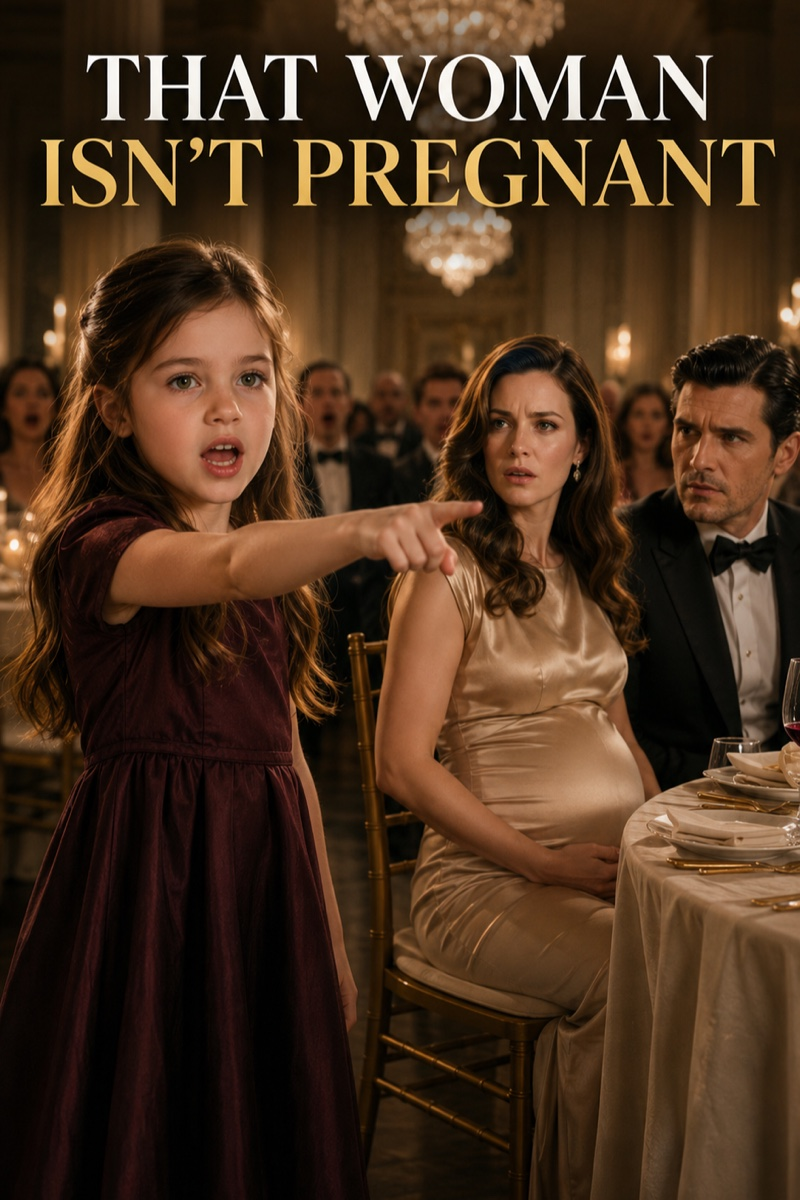
"My name is Nell Vance," she said. "Last year I had an allergic reaction at a luncheon."
The room went absolutely still.
"Somebody took my medicine out of my dad's jacket and put something else in his pocket, so that if he found anything at all, it would be the wrong thing."
She looked over at me, standing at the bottom of the steps.
"My dad did not forget."
I had to look at the floor.
"People say children don't always understand what adults are doing," she said. "Sometimes that's true. But we understand when we're frightened. And we always understand when an adult tells us to lie."
Several people in the front tables stopped looking at her.
"If a child tells you someone hurt them, please listen to them before you protect the adult's reputation."
The room stood up.
Nell did not smile until she got back to me.
"Was that okay?"
"You were perfect."
"Nobody's perfect, Dad."
"Fair."
She took my hand.
"Was it brave?"
"Yes."
"Even though I was scared the whole time?"
"That's what the word means."
The hospital used the evening to announce the Rebecca Hale Child Safety Initiative — allergy education, family advocacy, and independent support for children caught up in abuse investigations.
They asked whether Rosalind's historic donations should be redirected into it. I agreed only after the lawyers confirmed that none of that money had ever come out of Nell's trust.
They took her name off the plaque and put my wife's on it.
Not because Rebecca had money.
Because she tried to protect her daughter at a point when everyone closest to her had already become dangerous.
Elliot wrote to Nell three times in his first year inside.
Dr. Brooks kept the letters in her office.
Nell chose not to read them.
"I might one day," she said.
"That's yours to decide."
"Do you read his?"
"He writes to me too."
"Do you answer?"
"No."
"Will you ever?"
"I don't know."
She nodded, and that was enough for both of us for about three years.