"Step away from my daughter."
I got between Rosalind Hale and the hospital bed before she could take another step.
Nell was eight years old. She lay under a thin pink blanket with an IV taped to the back of her hand and an oxygen line resting beneath her nose. Her lips were still swollen. Her eyelids kept sliding closed and pulling themselves open again, the way they do when a child is fighting to stay in the room.
Three hours earlier, she had stopped breathing on the floor of a hotel ballroom.
Nell has had a severe peanut allergy since she was two. Every adult in our family knows it. Her medical bracelet was on her wrist that morning, in plain sight. I had spoken to the catering manager myself before the doors opened. I had two epinephrine auto-injectors in the inside pocket of my jacket, the way I have carried them every single day for six years.
A dessert crusted with chopped peanuts was set down in front of my daughter anyway.
She took one bite.
Then she grabbed my sleeve.
"Dad. I can't breathe."
I reached into my jacket.
The pocket was empty.
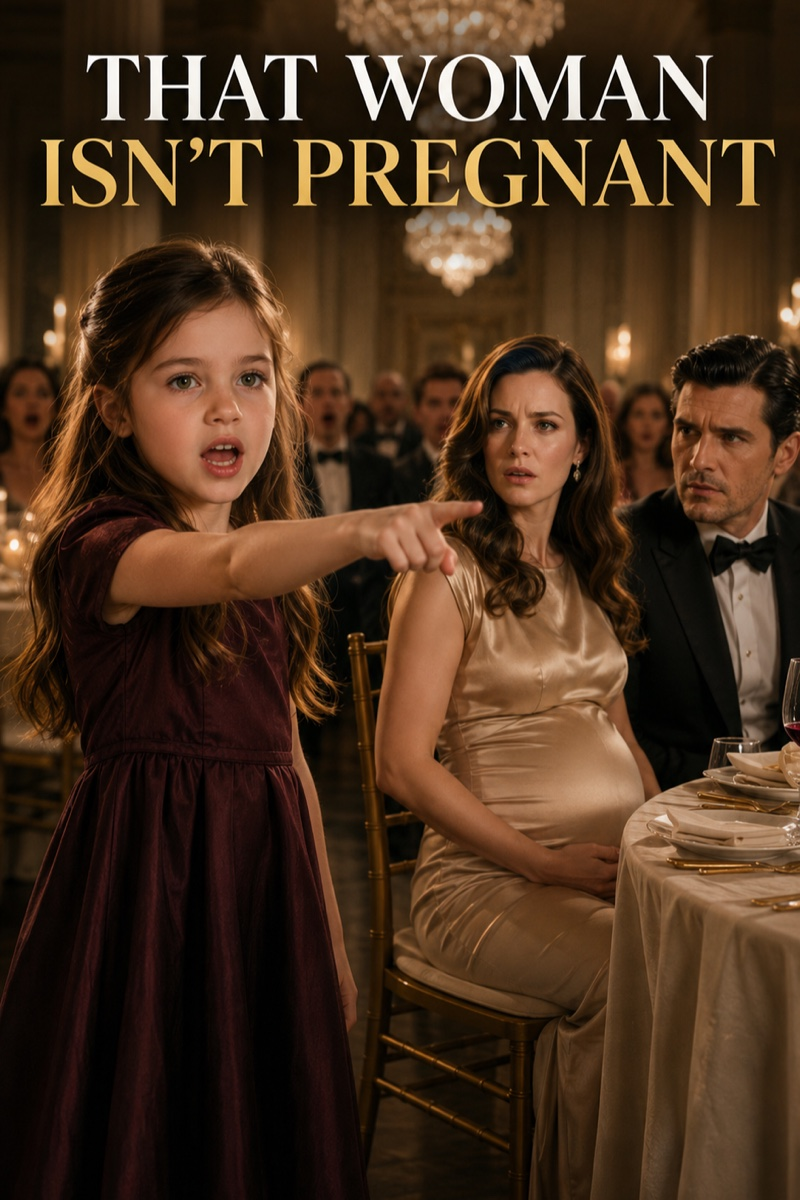
I checked the other side. I checked my trouser pockets. I went down on my knees and swept my hand under the table while my daughter's face changed color above me, and I was still shouting for an ambulance when Rosalind stepped up beside us, put her hand on my shoulder, and announced to four hundred donors that my daughter's father had forgotten her medication.
She did not whisper it.
She said it at the volume of a woman making an announcement.
By the time the paramedics reached our table, half that ballroom had already decided what kind of father I was.
Now Rosalind was standing inside the emergency room in a plum-colored suit that had not creased once all afternoon. Silver hair set. Makeup intact. She did not look like a grandmother who had spent three hours in a waiting room. She looked like a woman arriving to inspect a result.
"You need to leave," I said.
She glanced back toward the corridor. "No one stopped me."
"I'm stopping you."
Her mouth tightened.
Rebecca had been dead two years. Rosalind was Rebecca's mother, and from the week of the funeral she had worked at taking Nell away from me. She criticized how I fed her. She photographed ordinary playground bruises. She told relatives grief had made me unstable. She turned up at the school without permission and questioned teachers about my daughter's behavior. She said, in as many rooms as she could find, that a widowed man cannot understand what a little girl needs.
Until that afternoon I had believed she was controlling, and bitter, and that was all.
I had never once believed she would put my daughter's life on the table.
Rosalind stepped around me and leaned over the bed.
"You made quite a scene today," she said softly.
Nell opened her eyes.
Rosalind smiled at her. "You were frightened. Children remember things wrong after a medical emergency. Everyone understands that."
My daughter did not agree with her, and did not argue with her.
She just looked at her grandmother, and kept looking, the way an eight-year-old looks at an adult she has stopped believing.
Something in Rosalind's face gave way.
"You think you're clever, don't you."
"You will not speak to her," I said.
She did not even turn her head.
"If anyone asks you what happened," she told my daughter, "you will say your father forgot your medicine."
Then nobody said anything, for long enough that I could hear the monitor.
Nell's eyes came up.
"I know what you did," she said.
Rosalind's smile stopped.
"What did you say?"
"I saw you move the plates."
"You were confused, sweetheart."
"No." Nell's voice was thin, but it did not shake. "I was recording."
Before the luncheon, Nell had been sitting alone at the table with her mother's old smartwatch, dictating a voice memo about the two sentences she was supposed to say on stage. She was nervous about it. She had wanted to practice.
She never stopped the recording.
It caught the room. Four hundred people eating, a string quartet, somebody laughing two tables away. It caught a chair moving, and cloth, and a zip.
Then two voices, low, very close to the microphone. A man asking. My mother-in-law answering.
"Both?"
And Rosalind, unmistakably Rosalind:
"Yes."
"And the plate?"
"Where it needs to be."
Four seconds. Nine words. Nothing else.
The recording never caught the other person's face, and it never once said what any of it was for.
Rosalind straightened up very slowly. "That proves nothing at all."
The privacy curtain moved.
A man in a gray jacket stepped out from behind it, and I understood then why the nurse had asked me twice whether I wanted the curtain drawn.
Nell had told her doctor what she remembered as soon as she could talk. The doctor called hospital security. Security called the police. An hour before Rosalind walked in, a detective had asked my permission to wait in my daughter's room, and I had signed a form and said yes and then forgotten about it, because I had been awake for nineteen hours and I did not think anybody was coming.
Detective Mason Reed had been standing behind that curtain for eleven minutes.
"We'll let a judge decide what it proves," Reed said.
Rosalind turned for the door.
A uniformed officer was standing in it.
"This is outrageous," she said. "I came because I was worried about my granddaughter."
Reed lifted his hand.
He was holding a clear evidence bag, sealed, a chain-of-custody label taped across the front of it.
Inside was a single prefilled syringe. Not an auto-injector. A pharmacy syringe, capped, with a printed dispensing label wrapped around the barrel and a barcode running along the bottom edge.
"We took this out of your car forty minutes ago," Reed said. "It's over."
Rosalind looked at me for the first time since she had walked in.
"He planted it."
Reed did not answer her. He held the bag out sideways, toward the nurse at the medication cart, and the nurse did the most ordinary thing in the world.
She lifted her scanner and ran it across the barcode through the plastic.
The scanner beeped.
She read the screen.
Then she read the patient name out loud, the way nurses do, because reading it out loud is the safety check.
"Rebecca Hale."
My wife had been dead for two years.